Echelon Scholars

Echelon Scholars brings together selective admissions, one-on-one mentored research, and a singular focus on postgraduate-level publication. This combination has delivered an unbroken record of results for our high school students year after year. Where most summer programs stop at a standard research project, we guide students to create work that holds its own at the highest levels of competition. After years as a private, referral-only program, Echelon opened admissions to the public in 2025 and has run several successful cohorts since then.

Learn more

Echelon Logo All Blue

NSHSS handpicks its partners carefully, searching for nonprofits, organizations, and companies that directly align with our mission to provide the best resources for our members and their families. We may receive compensation from our partners, at no cost to you.

About the program:

We run cohorts each season and admit deliberately - historically just 20 high school students a year.

Every admitted student is paired with a published researcher from a school like Harvard, Stanford, Duke, or MIT, with no cap on mentoring time.

Our in-house panel of published academics and research scientists mirrors the exact process journals run, returning expert-level feedback directly to the student.

100% of our mentors published three or more times at the postgraduate level while they were still in high school, and 100% of their students have gone on to do the same.

Our story:

For admissions at the most selective universities, research is now table stakes. At Penn, a third of admitted students arrived with research experience; in Caltech's Class of 2027, nearly half had already conducted research in high school. And the advantage doesn't end with the acceptance letter. The labs and employers that students chase after college weigh research just as heavily.

However, participation and impact are not synonymous. Each year, roughly 200,000 American high schoolers take part in some form of research, competing for a pool of only about 12,000 Ivy League seats. The catch is that most of that work never reaches the level that genuinely prepares a student for serious academia, competitive industry roles, or the most selective admissions committees in the world.

Echelon Scholars was built by people who closed that gap themselves. As high schoolers, our founders did what almost no one their age does: they published in postgraduate, peer-reviewed journals. That work made their applications nearly impossible to overlook and gave them a real academic footing, the kind that carried them through Harvard, Stanford, and UC Berkeley. Echelon was founded on the desire to put that same caliber of research within reach of the next generation of students and scholars.

Echelonscholarsbuilding 2026

Alumni publication examples:

FAQS:

Absolutely. Our mentors have worked with high school students across the full spectrum of experience - from absolutely no exposure to research, to students who have been through a typical summer research program and published in student-led high school journals. Regardless of your prior knowledge with research projects, we are confident we can get you across the finish line to publishing at a post-graduate, peer-reviewed academic level for the first time.

At Echelon Scholars, to achieve our goals of postgraduate-level, peer-reviewed outcomes, we believe students must contribute to the state-of-the-art. Thus, our research opportunities focus on interdisciplinary research where there is at least one element of technical skills used, such as AI/ML, data science, molecular biology, statistics, applied math, and medical research. Our high school students have done research on a huge variety of fields, from cutting-edge biomedical research to using neural network algorithms to do cash-flow-based financial underwriting for credit cards to using data science for tracking animal migration patterns. All original research topics are ultimately chosen by our students after conducting a thorough literature review with their mentors, as is done in top university labs and research institutes - a high standard most summer research programs do not adhere to.

Generally speaking, most high schoolers submit and publish work to 3 different types of venues:

  1. high school level venues such as the Journal of Emerging Investigators and YSJ
  2. undergraduate-level peer-reviewed venues, such as the Journal of Undergraduate Research
  3. postgraduate-level, peer-reviewed venues, such as the IEEE and ACM

Although high school and undergraduate outcomes are a great starting point for high school students, the highest quality of all work gets published in postgraduate, peer-reviewed venues. Only a few high schoolers achieve this each year, making those who do instantly stand out. As such, Echelon Scholars only targets publications like these.

Meet our founder:

Pranav Kulkarni

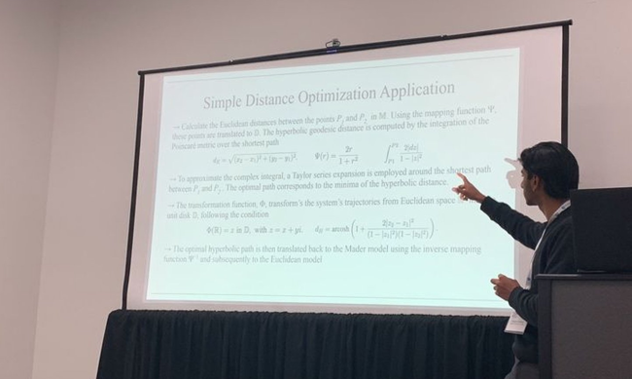
Pranav Kulkarni is the Executive Director at Echelon Scholars, a researcher at the Stanford Artificial Intelligence Laboratory (SAIL), a 15x published researcher, and an inducted member of the SoftBank Masayoshi Foundation. While in high school, Pranav invented a corollary to the Newton–Gauss Theorem, earning Best Paper Award at the IEEE ICKII Conference, becoming the youngest recipient in the conference’s history. His research has since been cited in numerous postgraduate venues, and he has been invited to speak at 10+ international conferences, including those hosted by the IEEE, the American Mathematical Society, and MIT.

During his senior year of high school, Pranav was accepted to every university he applied to, including Stanford, Princeton, UC Berkeley, and Cornell. He chose to attend Stanford University to pursue a dual degree in Mathematics and Computer Science. Alongside his academic pursuits, Pranav is a venture-backed entrepreneur who has founded and advised multiple companies in AI, consulting, and energy systems. Pranav founded Echelon Scholars to help high-school students publish at the postgraduate level, a mission that has led to 100% publication success and over 50 peer-reviewed papers in venues such as IEEE. Beyond research, Pranav is dedicated to helping students gain admission to world-class universities and transform their lives through the same opportunities that research once opened for him.